Why Notion's Onboarding Quietly Works
How peak-end and social proof turn a blank canvas into a place worth returning to
Onboarding is mostly decided in the first ten seconds and the last ten seconds.
A Blank Canvas Marked With Strangers’ Traces
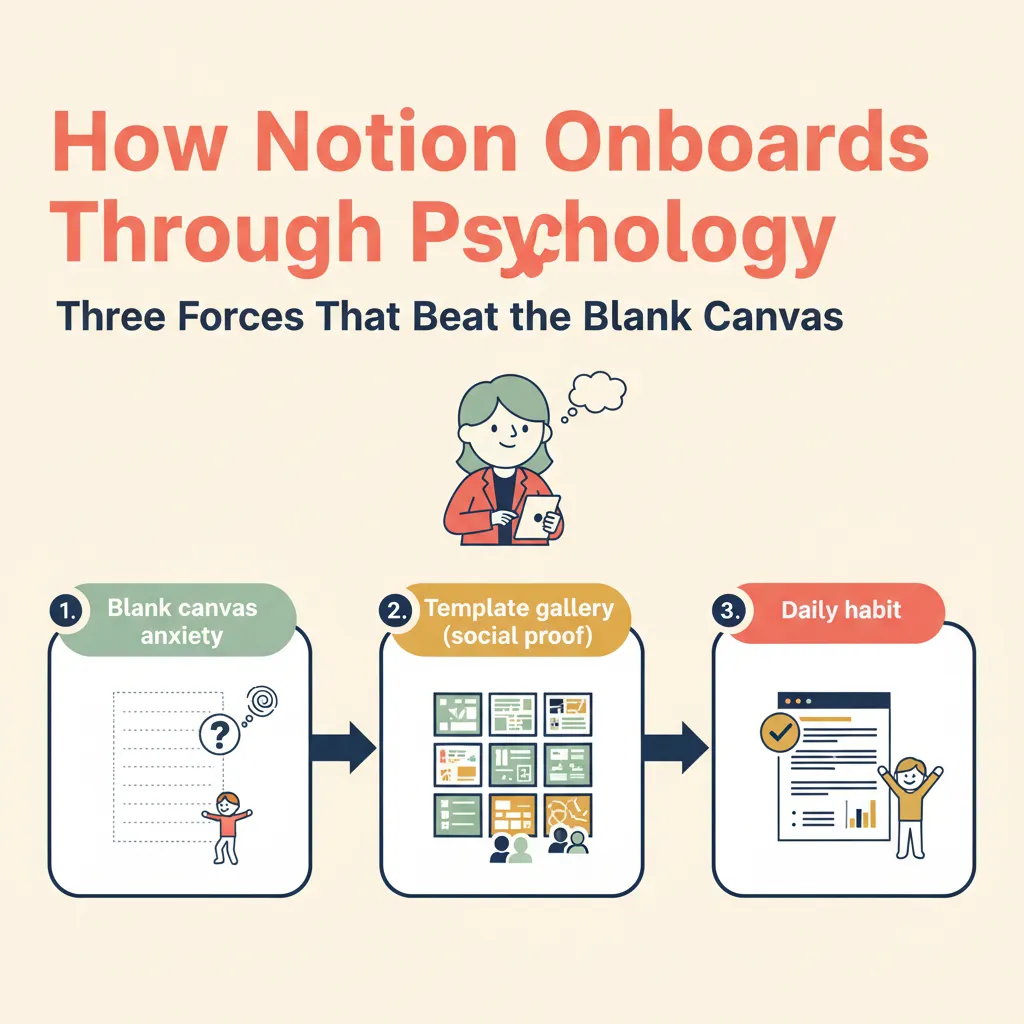
Almost everyone who opens Notion for the first time sees the same thing: a blank page, a quiet welcome line, a row of templates, and the residue of how strangers have used the product before — Daily Journal, Reading List, Project Tracker.
It looks ordinary. But the path is, by the textbook, an applied case of two old biases: social-proof and the peak-end-rule.
Social Proof Is Quieter Than Loud Numbers
Social proof is usually associated with loud numbers — “1,000,000 users.” Inside SaaS onboarding, the active version is much quieter.
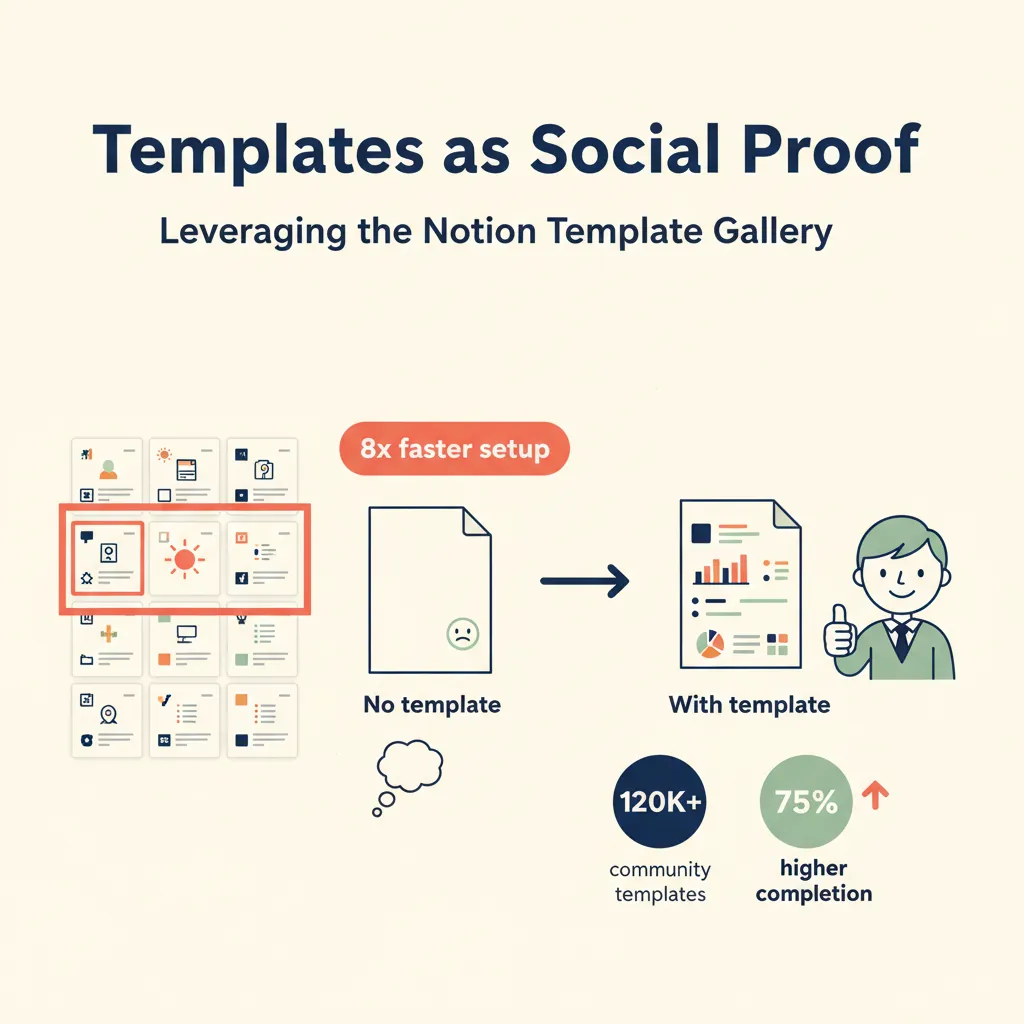
New users respond less to badges and more to the visible artefacts of how other people have already used the tool. Notion’s template gallery is, fundamentally, a sample book of other people’s lives and jobs.
The fact that someone built a Reading List grants permission to build one too, and that permission collapses the psychological cost of facing the blank canvas.
We Remember Only the Peak and the End
The peak-end rule, demonstrated by Kahneman and colleagues in their 1993 cold-water experiment, says people remember an experience as the average of its most intense moment and its ending — not as the average of all moments lived.
Apply this to onboarding and the implication is sharp: nobody recalls what happened across the first five minutes. They recall the moment something first clicked, and how the session ended.
In Notion, the click happens when a template loads with the user’s own name already filled in. That is the peak.
Onboarding is not the work of conveying information. It is the work of designing memorable seconds.
Optimize Memory Quality, Not Pass-Through Rates
Read this through a funnel lens and the picture inverts. The team is not optimizing pass-through rates so much as the memory quality at each step.
In the first 90 seconds, the user earns a small but real sense of ownership: this is my page. That is the peak.
Just before they close the first session, something has to give them a reason to come back tomorrow. The invite UI, the home-screen prompts, and the mobile sync notification are devices that fix the ending in a particular state — unfinished but warmly resumable.
Three Principles Hit at Once
A May 2026 piece in HBR argues that personalization is now best designed as the application of psychology principles, not as data-driven optimization.
Of the five principles the article lists, Notion’s onboarding hits at least three at once: self-relevance (your name is already there), social validation (other people’s templates), and immediate accomplishment (one click produces a finished-looking artefact).
None of these is a flashy lever. The product is the cumulative effect of trimming half a second of friction from many small surfaces.
The lesson is not “show templates.” The lesson is to ask, before tuning a single funnel number, what the user actually remembers about the product. Products that consciously design the first move and the final feeling earn their second session without adding a single feature.
Sources: HBR, “Personalization Through 5 Psychology Principles” (2026); Kahneman, Fredrickson, Schreiber & Redelmeier (1993) on the peak-end rule.
Related Articles

If AI Can't Find You, Your Business Doesn't Start — Adobe CEO on the Agentic AI Gap
Why B2B Buyers Choose Their Favorite, Not the Best
Designing Sound That Sticks: Brand Memory Lessons from Composer Hiroyuki Sawano
How Anchoring Quietly Shapes SaaS Pricing
Why Prices Ending in 9 Still Sell